


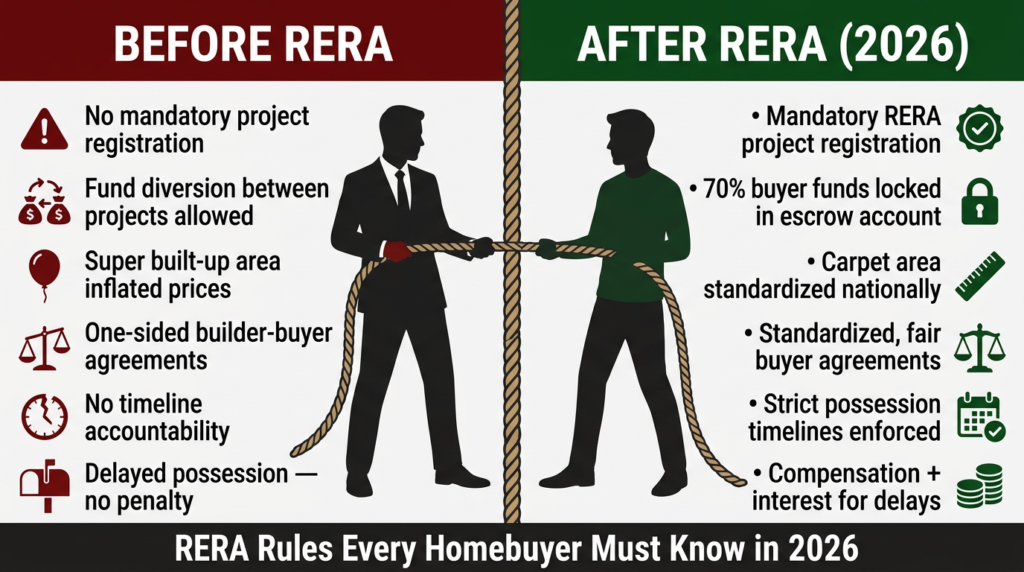
Buying a home remains one of the biggest financial decisions for Indian families. However, concerns about delayed possession, hidden charges, incomplete projects, and a lack of transparency have historically posed major challenges for buyers.
The launch of the Real Estate Regulatory Authority, or RERA, brought more accountability and legal protection for homebuyers, changing how real estate works in India.
In 2026, knowing RERA rules is especially important as more people look to buy homes in cities like Gurgaon, Faridabad, Noida, Greater Noida, Bengaluru, Mumbai, Hyderabad, Pune, and Delhi.
Whether you are buying your first apartment or investing in a property that is still being built, understanding your legal rights can help you make safer and smarter choices.
What Is RERA and Why Was It Introduced?
The Real Estate Regulatory Authority was introduced under the Real Estate Regulation and Development Act, 2016.
RERA’s main goal is to make India’s real estate sector more transparent, accountable, and efficient.
Before RERA, buyers often faced issues such as:
- Delayed project completion
- Misleading project advertisements
- Sudden layout changes
- Hidden charges
- Lack of legal recourse
RERA created a structured framework that requires developers and agents to follow defined regulations before selling properties.
Mandatory RERA Registration for Projects
One of the most important RERA rules in India is the mandatory registration of projects.
Developers have to register both residential and commercial projects with the state RERA authority before they can advertise or sell any units.
Why This Matters
When a project is registered, buyers can access important details such as:
- Project approvals
- Construction status
- Delivery timelines
- Land ownership details
- Litigation status
Homebuyers should always check the RERA registration number before booking any property that is still under construction.


Builders Must Deliver Projects on Time
Project delays were one of the biggest problems in Indian real estate before RERA.
Under RERA rules, developers are legally required to deliver projects within the committed timeline specified at the time of registration.
If Delays Happen
Buyers may be eligible for:
- Compensation
- Interest payments
- Refund options in certain cases
This provision has significantly increased accountability among developers.
However, buyers should still read the agreement carefully, since unexpected events or regulatory delays can affect the timeline.
Carpet Area Definition Is Standardised
Before RERA, developers often used confusing terms like super built-up area and saleable area when marketing apartments.
RERA introduced a clear and standard definition for carpet area.
Carpet Area Includes
- Usable floor space inside the apartment walls
Carpet Area Excludes
- Balconies
- Terraces
- Common areas
- External walls
This rule makes pricing clearer and helps buyers compare different projects more easily.
Advance Payment Restrictions Protect Buyers
Developers are not allowed to take more than 10 percent of the property cost as an advance before a formal sale agreement is signed.
This rule protects buyers from having to make large, unsecured payments early in the project.
It also ensures that contractual obligations are clearly documented before major financial commitments are made.
Separate Escrow Accounts for Project Funds

One of RERA’s strongest financial protections is the use of escrow accounts.
Developers have to put a large part of the buyers’ money into a separate account for the project.
Purpose of This Rule
- Prevent fund diversion
- Ensure construction continuity
- Improve financial discipline
This regulation helps reduce the risk of stalled or abandoned projects resulting from the misuse of funds.
Buyers Have the Right to Information
RERA makes things more transparent by giving buyers access to important project details.
Developers must regularly update:
- Construction progress
- Project approvals
- Completion timelines
- Unit inventory status
These updates are usually available on the official state RERA websites.
This helps buyers keep track of how the project is progressing.
Structural Defect Liability for Five Years
RERA makes developers responsible for fixing any structural defects for five years after buyers take possession.
This includes issues related to:
- Construction quality
- Plumbing
- Electrical systems
- Structural workmanship
If buyers report defects within these five years, developers are expected to fix them within the set time.
Real Estate Agents Must Also Register
RERA rules cover not just developers, but also property agents and brokers.
Registered agents have to follow ethical business practices and be transparent during property deals.
Homebuyers should choose RERA-registered brokers to lower legal and paperwork risks.
State-Level RERA Variations Buyers Should Know
Although RERA operates under central legislation, implementation differs slightly across states.
For example:
- Maharashtra RERA
- Karnataka RERA
- Uttar Pradesh RERA
- Haryana RERA
These states may have different procedures and online systems.
Homebuyers should always check the rules that apply in the state where the property is located.
Common Mistakes Buyers Still Make Despite RERA
Even with these legal protections, buyers still sometimes make mistakes that could be avoided.
Common Mistakes Include
- Ignoring project registration verification
- Not reviewing the builder’s track record.
- Overlooking agreement clauses
- Assuming possession timelines are guaranteed
- Focusing only on launch discounts
RERA gives buyers more protection, but it’s still important to do your own careful checks.
How RERA Has Changed Indian Real Estate
RERA has made India’s property market much more transparent and professional.
The law has encouraged:
- Greater buyer confidence
- Improved developer accountability
- Better project documentation
- Faster dispute resolution
- More organised real estate practices
There are still some challenges, but the real estate sector is much more regulated now than it was before RERA.
Conclusion
Every homebuyer in 2026 needs to understand RERA rules. RERA covers things like project registration, delivery timelines, compensation rights, and construction accountability, giving buyers important legal protection from common real estate risks.
Before investing in any residential project, buyers should check the RERA registration details, read all documents carefully, and make sure the property follows the rules for that state.